Why the Release Checker Is Called rmqa
rmqa stands for release manifest QA. Each part of the name is one idea, and together they describe the whole tool.
Release. Not the build, not the code, not the pipeline. The release is the set of files people download: the archives, the bare programs, the checksums. It’s the one product of a software project that users see directly, and it’s assembled at the very end, often by a script that was written once and rarely looked at again.
Manifest. On a ship, the manifest lists what the ship is carrying, and a port can check the cargo against it. rmqa’s manifest does the same for a release: which downloads, for which platforms, holding which programs and which files. It’s written once and checked every time.
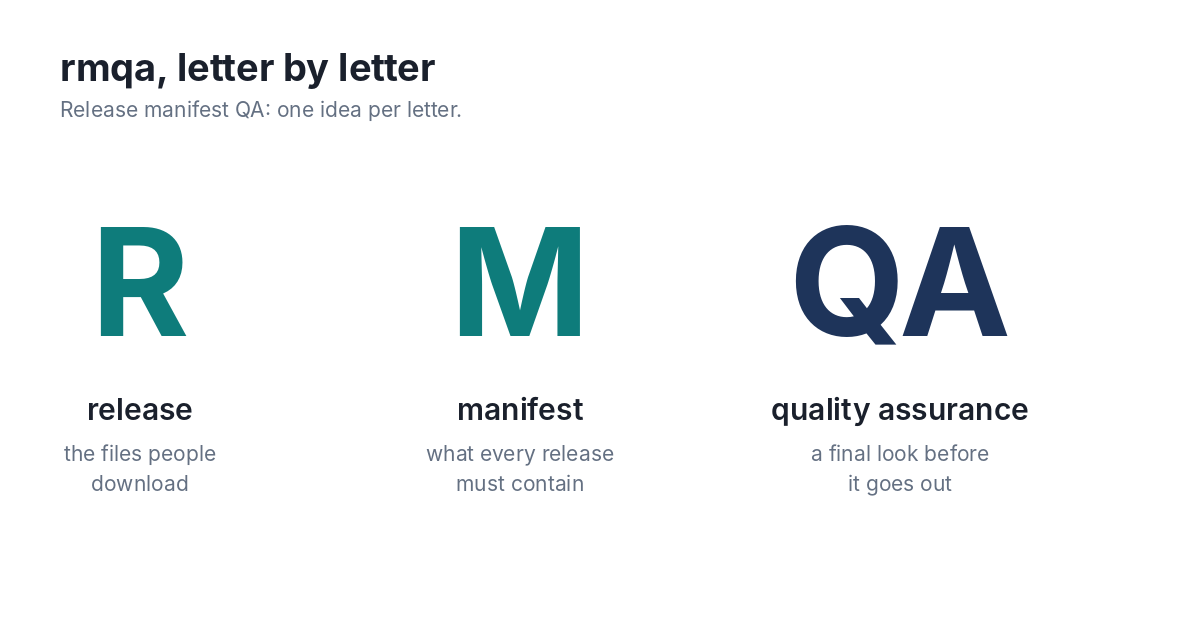
QA. Quality assurance, in its plainest sense: someone looks at the finished thing before it goes out. Factories have had a final inspection for a long time. Software releases mostly haven’t, because every step before the last one was tested, and it’s easy to assume the sum of tested steps is a tested release.
It isn’t. A build script that copies the wrong file into an archive passes every test the code has. So does a checksums file made before an archive was rebuilt.
Four Letters
The name is short because it’s typed a lot: in a terminal, in a CI file, in uses: softdevstudio/rmqa@v0.1.2. Four letters that don’t spell a word are also easy to find. A search for rmqa finds this tool, not a dictionary.
Say it letter by letter, R-M-Q-A. The program is rmqa, the manifest is rmqa.toml, and the site is rmqa.com.